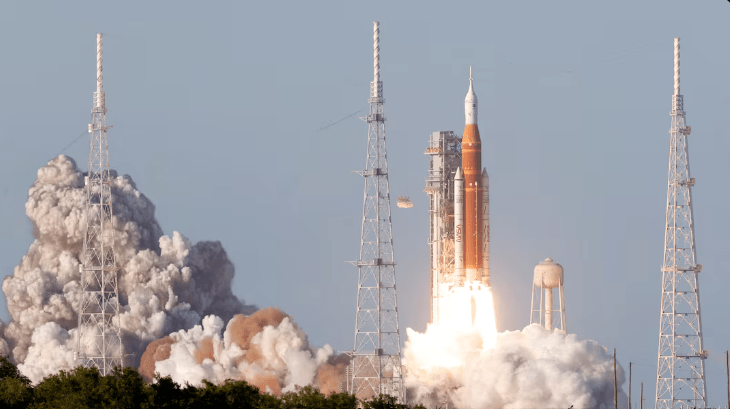
Ahead, the four crew members – NASA astronauts Reid Wiseman, Christina Koch and Victor Glover, and the Canadian Space Agency’s Jeremy Hansen – will venture farther in space than anyone in human history. The mission will make Glover the first Black man to venture within the vicinity of the moon, while Koch will become the first woman and Hansen the first Canadian to do so. NASA’s Artemis II mission got off the ground at 6:35 p.m. ET Wednesday, April 1, from the Kennedy Space Center in Cape Canaveral, Florida. The Artemis programme has taken years of work, involved thousands of people and is estimated to have cost $93bn to date.
Primarily considered a test mission, Artemis II could represent a giant step toward NASA’s goal of returning astronauts to the lunar surface for the first time since the Apollo missions came to an end in 1972. The mission, expected to last about 10 days, is a critical demonstration that NASA’s Orion crew capsule can handle a lunar mission with humans aboard before a landing is attempted as early as 2028.
The Artemis II astronauts are still orbiting Earth in NASA’s Orion s Want to follow the astronauts along the Artemis II lunar journey? NASA has an Artemis II tracker available online and on its mobile app that allows users to see where Orion is, how fast it’s traveling and how far the spacecraft is from both the Earth and the moon space capsule. What followed the launch was a series of complex steps within the first few hours of the mission to set the stage of the Artemis II crew to begin the 10-day journey around the moon in the Orion capsule. If all goes according to schedule, Artemis II is due to reach the moon and make a historic lunar flyby Monday, April 6.
We are returning to the Moon through NASA’s Artemis program to establish a sustainable long-term human presence, test technologies for future Mars missions, conduct advanced scientific research, and secure economic/strategic advantages in space. Artemis II, specifically, tests systems for future crewed landings and lunar base development. Here are the main reasons of going to the moon:
- Valuable Resources– “An example is rare earth elements, which are very scarce on Earth, and there might be parts of the Moon where these are concentrated enough to be able to mine them (BBC).
- Race for Space Dominance – So the big thing right now is to try to grab your piece of land. You can’t own it, but you can use it. And once you’re there, you’ve got it for as long as you want it.
- Paving Their Way to Mars– On a Moon base, Nasa can perfect the tech to provide the air and water astronauts need. They’ll have to work out how to generate power and build habitats to protect people from extreme temperatures as well as dangerous space radiation.
- Mysteries Yet to be Unlocked- Because the Moon was once a part of the Earth, it holds a record of 4.5bn years of our own planet’s history. And with no plate tectonics, or wind and rain to wipe this record away, the Moon is a perfect time capsule. “The Moon is a fantastic archive of the Earth,” says Russell. “A new haul of rocks from a different area of the Moon would be amazing.”
- Inspiring a New Generation- It’s hoped that the Artemis missions – streamed live and in 4k – will inspire a new generation.”We live in a world of technology. We need scientists, engineers and mathematicians – and space has a brilliant ability to excite people about those subjects,” says Libby Jackson.
The Artemis program is praised for fostering international partnerships and returning humans to the Moon to include women and people of color, but criticized for extreme costs (>$60B), sustainability concerns, and technical delays with its SLS rocket. Key issues include the shrinking lunar surface posing landing challenges and reliance on expensive, non-reusable tech.
The Artemis program faces significant challenges, including ballooning costs, technical issues like Orion heat shield erosion, and years-long launch delays (e.g., Artemis II now slated for 2025). Other major hurdles include developing complex lunar landers, designing new spacesuits, relying on unproven large-scale cryogenic orbital refueling, and navigating tight federal budgets.


Leave a Reply